Modern beekeeping can sometimes become a constant cycle of opening hives, rearranging frames, adding and removing boxes, feeding supplements, moving colonies, and trying to manage nearly every decision the bees make. Natural beekeeping begins with a different question: What happens when we give the bees a suitable home, adequate natural resources, and then interfere as little as reasonably possible?
This low-intervention philosophy does not mean abandoning the bees or ignoring disease, starvation, or dangerous parasite levels. It means distinguishing between intervention that is genuinely necessary and intervention that has simply become routine.
Natural beekeeping is not about doing nothing. It is about doing what is necessary, harvesting responsibly, watching carefully, and otherwise allowing the colony to live according to the rhythms of the bees rather than the convenience of the beekeeper.
A Permanent Home Instead of a Traveling Hive
In this approach, the hive is placed in a carefully selected location and remains there year after year. The bees learn the surrounding landscape, establish their flight paths, and forage from the flowers, trees, gardens, fields, and wild plants available around their permanent home.
Commercial pollination operations may move colonies long distances because mobility is part of their business model. A stationary natural apiary has a very different purpose. The objective is to establish a colony as a permanent part of the local environment rather than as a unit that must repeatedly be transported to different crops.
Location therefore becomes extremely important. The beekeeper should consider forage throughout the season, access to clean water, drainage, wind protection, summer heat, winter exposure, pesticide risks, and whether the surrounding landscape can support the number of colonies being kept.
The Horizontal Hive
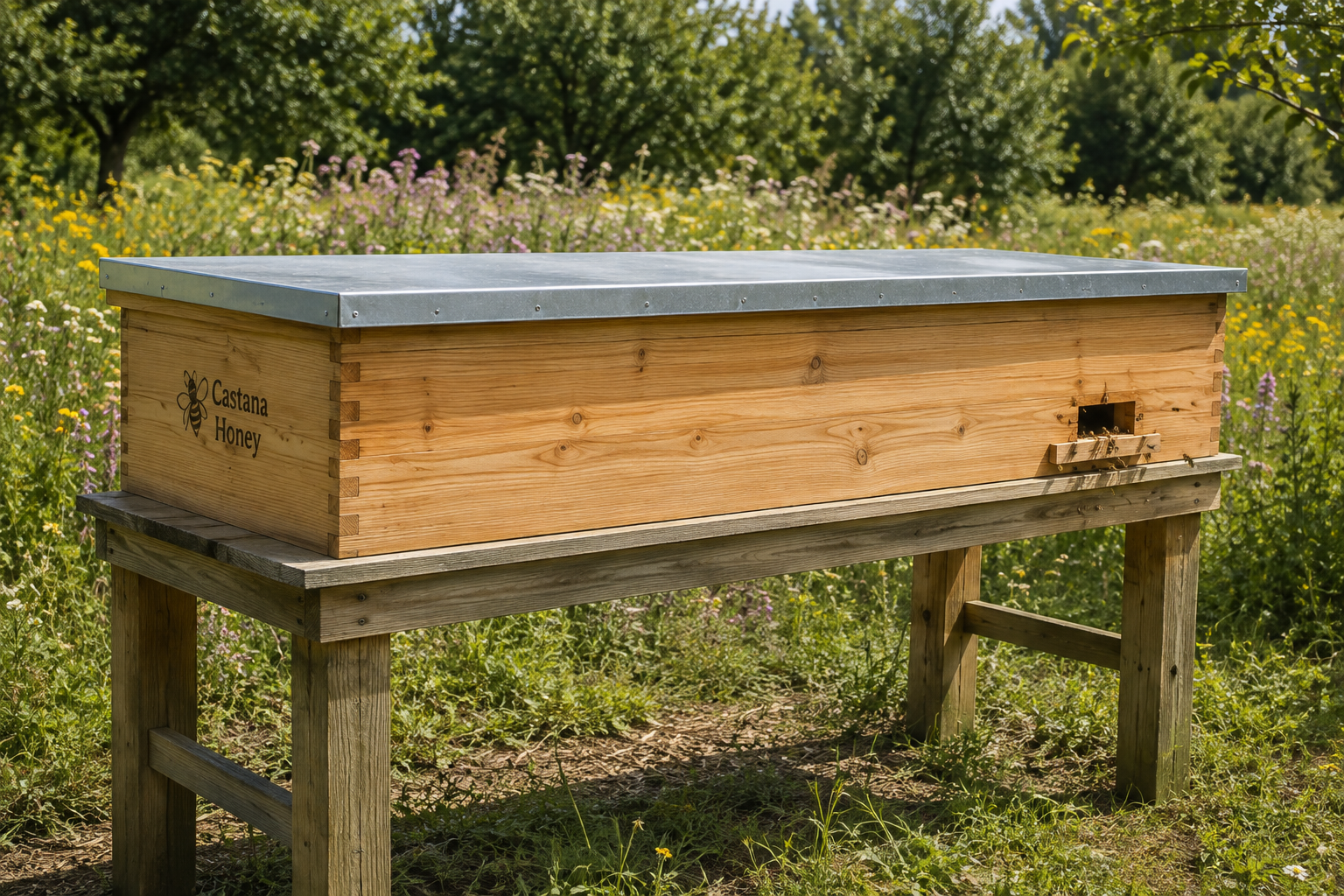
One hive style particularly well suited to this philosophy is the horizontal hive. Instead of continually expanding upward by stacking one heavy box on another, the colony occupies a long horizontal body. Depending on the design, the beekeeper can provide additional room along the length of the hive as the colony grows.
For the beekeeper, one obvious advantage is accessibility. Individual frames can be inspected without repeatedly lifting full supers. This can make beekeeping considerably easier for people who have difficulty lifting heavy boxes or simply prefer working at approximately waist height.
Horizontal hives also fit naturally with a permanent-apiary philosophy. Rather than building a tall tower of boxes that changes throughout the season, the bees live in one substantial structure. Different horizontal designs manage brood and honey space differently, so there is no single horizontal-hive method that is right for every beekeeper or climate.
Three or Four Major Inspections Instead of Constant Disturbance
A natural beekeeper may aim for only three or four thorough hive openings during the year, when colony conditions and local circumstances allow. This is a management philosophy rather than a rigid calendar rule.
Every time a hive is opened, the colony's internal environment is disturbed. Frames are separated, bees are moved, propolis seals may be broken, and heat and scent can escape. There are times when that disturbance is justified. The goal is simply not to disturb the colony without a reason.
What might those inspections accomplish?
- Spring: confirm that the colony survived winter, has a functioning queen, has adequate food, and is building normally.
- Late spring or early summer: evaluate colony strength, available space, swarm conditions, brood health, and parasite pressure.
- Harvest season: determine whether there is truly surplus honey that can be removed without depriving the colony.
- Autumn: verify that the colony is healthy, appropriately sized for winter, and has sufficient stores for the months ahead.
Those major inspections do not mean ignoring the hive between openings. Experienced beekeepers can learn a remarkable amount by watching the entrance. Flight activity, pollen being carried inside, unusual numbers of dead bees, fighting or robbing, discarded brood, unusual odors, and changes in behavior can all provide information without dismantling the colony.
The Bees' Honey Is Their Food
Perhaps the most important principle in this style of beekeeping is simple: honey belongs to the bees first.
Bees spend the flowering season gathering nectar, concentrating it, storing it in wax cells, and converting it into the food reserve that carries the colony through periods when flowers are unavailable. In cold climates, those stores are particularly important because the colony may be unable to forage for extended periods.
A low-intervention beekeeper therefore harvests conservatively. Rather than removing as much honey as possible and automatically replacing the colony's food with sugar syrup, the beekeeper determines what the bees need and takes only the genuine surplus.
The philosophy is straightforward: leave enough of the bees' own honey so that routine replacement feeding is unnecessary whenever nature and the season make that possible.
Why Avoid Routine Sugar Syrup?
Refined sugar syrup provides bees with carbohydrates, and conventional beekeeping uses it for several legitimate purposes. It can help establish new colonies, encourage comb building, compensate for a nectar dearth, or prevent starvation when winter stores are inadequate.
Natural beekeeping asks whether routine feeding is necessary when an established colony already has adequate honey. Nectar is the bees' natural carbohydrate source, and honey is the food they have produced from that nectar for storage. If the colony can maintain sufficient natural stores, there is little reason to replace those stores simply as a matter of habit.
There is another practical reason to keep feeding separate from honey production: sugar syrup can be stored in comb. If syrup is fed while bees are filling honey intended for human harvest, the harvested product can contain stored syrup rather than being entirely produced from floral nectar.
What About Pollen Patties and Other Supplements?
Bees naturally obtain protein, fats, vitamins, minerals, and other nutrients from pollen collected from flowering plants. A diverse landscape containing blooms throughout the season gives colonies access to a changing variety of natural pollen and nectar sources.
In a natural-beekeeping system, routine protein patties and stimulative feeding are generally avoided when the colony has adequate natural forage. The beekeeper instead places greater emphasis on the environment surrounding the hive: flowering trees, clover, wildflowers, herbs, gardens, native plants, and other sources that bloom at different times.
Again, this is a philosophy rather than an absolute rule. Severe drought, unusual weather, a newly established colony, or an emergency shortage can change what responsible management requires.
Less Manipulation Does Not Mean Ignoring Varroa
Natural beekeeping should not be confused with simply refusing to monitor the colony. Varroa mites and the viruses associated with them can seriously weaken or kill honey-bee colonies. A hive that looks busy at the entrance can still have a dangerous mite population.
The low-intervention beekeeper should have a plan for assessing colony health and parasite pressure and should understand the consequences of whatever treatment or treatment-free strategy is chosen. The principle of minimal intervention means avoiding unnecessary disturbance—not ignoring a serious threat until the colony collapses.
Allowing the Colony to Organize Its Own Home
Honey bees have been organizing colonies far longer than humans have been keeping them in manufactured hives. Within the nest, workers regulate temperature, move food, feed brood, store pollen, build comb, ventilate the colony, guard the entrance, and respond continuously to changes in weather and forage.
Low-intervention management gives that biological system room to function. The beekeeper still provides appropriate equipment and sufficient space, but resists the temptation to continually rearrange the colony simply because the frames do not look exactly as the beekeeper expected.
Watching Instead of Constantly Opening
Natural beekeeping changes the beekeeper's role from constant manager to careful observer. Instead of asking, "What can I do inside the hive today?" the question becomes, "What are the bees telling me, and do they actually need my help?"
Entrance observation can become one of the beekeeper's most useful skills. Healthy traffic, returning foragers carrying pollen, orientation flights, wax debris, drones, guard behavior, robbing attempts, and seasonal changes all become part of learning the colony.
When something looks wrong, the hive can be opened. Minimal inspection should never mean refusing to investigate evidence of queen loss, disease, starvation, robbing, excessive mites, or other serious problems.
Harvest the Surplus, Not the Winter Pantry
Honey harvesting looks different when winter survival takes priority over maximum yield. Before removing honey, the beekeeper asks how much the colony will require before dependable nectar returns.
That amount varies considerably with climate, colony size, winter length, and local forage. Northern colonies may require very substantial reserves. Consequently, responsible natural beekeeping cannot use a single number for every hive everywhere.
If the colony has produced a generous surplus, the beekeeper can enjoy a harvest. If it has not, there may simply be little or no honey to harvest that year. Accepting that possibility is part of putting colony survival ahead of maximum production.
A Different Measure of Success
Conventional production systems often measure success in pounds of honey, number of colonies, pollination contracts, or annual output. Those are reasonable measurements for a commercial operation.
Natural beekeeping can use another measure: Can this colony establish itself, remain healthy, maintain adequate stores, overwinter successfully, and continue living in the same home year after year with relatively little intervention?
A colony that produces a modest harvest but survives year after year may be more satisfying to a natural beekeeper than one pushed for maximum production and continually dependent on replacement food and intensive management.
The Principles of Low-Intervention Natural Beekeeping
- Give the colony a permanent, carefully chosen home.
- Consider a horizontal hive that can remain in place year after year.
- Open the hive with a purpose rather than according to an unnecessarily frequent schedule.
- Learn to observe the colony from outside the hive.
- Encourage abundant, diverse natural forage.
- Allow bees to rely primarily on nectar, pollen, and the honey they produce.
- Avoid routine sugar syrup and supplements when natural stores are adequate.
- Harvest only genuine surplus honey.
- Leave sufficient honey for winter and periods of dearth.
- Monitor serious threats such as Varroa even when practicing minimal intervention.
- Intervene when necessary to prevent avoidable colony loss.
The Bottom Line
Natural beekeeping is not a competition to see who can do the least work. Neither is it a promise that bees can survive every circumstance without human assistance. Once we place honey bees in managed hives, we accept some responsibility for their welfare.
But responsible care does not necessarily require constant manipulation. A permanent horizontal hive, a rich local landscape, conservative harvesting, adequate natural honey stores, careful observation, and a few purposeful inspections can form the basis of a much quieter relationship between beekeeper and colony.
Sometimes good beekeeping is knowing when to open the hive. Natural beekeeping also teaches us something equally important: knowing when to leave it closed, stand nearby, watch the entrance, and simply let the bees be bees.