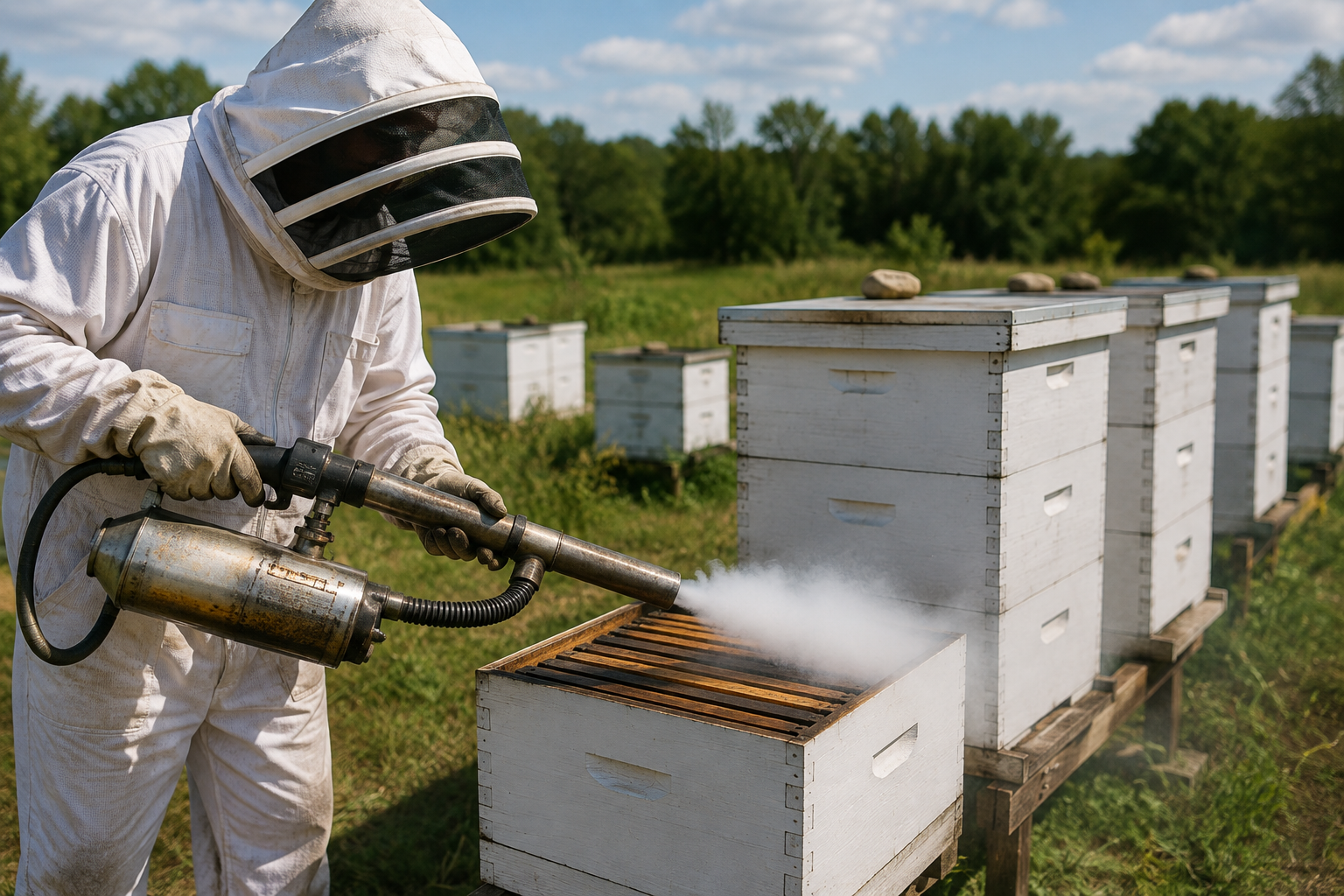
Modern beekeeping faces a difficult challenge: honey bees are threatened by parasites, diseases, viruses, pests, poor nutrition, and environmental stresses. Of these threats, the Varroa destructor mite has become one of the most serious problems facing managed honey bee colonies.
To protect colonies, many commercial and hobby beekeepers use treatments designed to control mites and other hive problems. Some are synthetic pesticides, while others are organic acids, essential-oil-derived compounds, or medications. These products can be important tools for keeping colonies alive, but their use also raises a reasonable question for consumers: can treatment chemicals end up in honey or beeswax, and could those residues pose a risk to people?
The answer requires some perspective. An approved treatment used correctly according to its label is not the same thing as indiscriminately putting dangerous chemicals into honey. At the same time, hive treatments are biologically active substances, and misuse, excessive application, treatment at the wrong time, or persistent residues in wax can create legitimate concerns.
Why Do Beekeepers Treat Their Hives?
The primary reason for many modern hive treatments is Varroa destructor. These parasitic mites feed on developing and adult honey bees and contribute to the spread of damaging viruses. If mite populations become severe, an apparently strong colony can weaken dramatically and eventually collapse.
This puts beekeepers in a difficult position. Doing nothing can allow parasites and disease to overwhelm a colony, while treating a colony requires choosing a method that is effective without unnecessarily exposing bees, comb, or harvested products to treatment residues.
Common Treatments Used in Beekeeping
Amitraz
Amitraz is a synthetic acaricide used in some commercial Varroa-mite treatments. It is designed to kill mites while being tolerated by the honey bee colony when the approved product is used according to its directions.
Like other pesticides, however, amitraz must be used correctly. Treatment timing, dosage, application method, and restrictions concerning honey supers matter. Researchers also monitor amitraz and its breakdown products because residues can potentially be detected in hive materials.
Fluvalinate
Fluvalinate is a synthetic pyrethroid that has been used for Varroa control. One concern with compounds of this type is their ability to persist in beeswax. Because comb may remain in a hive for years, wax can act as a reservoir for certain fat-soluble chemicals.
Another problem is resistance. Repeated exposure to the same treatment can select for mite populations that are less susceptible to it, reducing the treatment's usefulness.
Coumaphos
Coumaphos is an organophosphate compound that has historically been used against certain honey bee pests. Like fluvalinate, it has attracted attention because residues can accumulate in beeswax.
Persistent contamination of old comb is one reason many beekeepers periodically replace brood comb rather than keeping the same wax indefinitely.
Formic Acid
Formic acid is naturally occurring and is used in certain Varroa-control products. It differs from some synthetic pesticides because it is volatile and does not behave in wax in the same manner as persistent fat-soluble compounds.
"Naturally occurring," however, does not mean harmless in every circumstance. Concentrated formic acid can be hazardous to the beekeeper handling it, and application conditions such as temperature and dosage are important for colony safety.
Oxalic Acid
Oxalic acid is another compound used to control Varroa mites, particularly when little or no capped brood is present. It can be administered using approved methods such as solution application or vaporization, depending on the product and applicable regulations.
Oxalic acid also occurs naturally in many foods and plants, but concentrated oxalic acid used as a treatment still requires careful handling. Beekeepers must follow the product label and protect themselves from inappropriate exposure, particularly when vaporization is involved.
Thymol
Thymol is a naturally occurring component associated with thyme and is used in some mite-control products. It is another example of a treatment that may be described as "natural" but nevertheless has biological activity and must be applied at the correct dose and under appropriate conditions.
Can These Substances Get Into Honey?
The possibility depends heavily on the substance, how it is used, when it is used, and where it accumulates. Honey and beeswax are very different materials chemically. Some compounds have a greater tendency to accumulate in wax than in honey, while others break down or dissipate more readily.
This is why treatment labels can contain specific restrictions regarding application while honey supers are present. Following those restrictions is an important part of keeping treatments separate from honey intended for human consumption.
The important question is not simply, "Was this hive ever treated?" It is: "What was used, how was it used, when was it used, and were the required label directions followed?"
Beeswax Deserves Special Attention
Beeswax is particularly interesting because some compounds are attracted to fats and can remain in wax much longer than they remain in honey. A hive may contain comb that has been reused season after season.
As a result, residues from certain historical treatments and environmental pesticides can accumulate in wax. This does not automatically mean the honey stored in that comb is unsafe, but it demonstrates why responsible treatment practices and comb management matter.
Beekeepers interested in minimizing residues may rotate out old comb, avoid unnecessary treatments, monitor mite levels before deciding to treat, and carefully follow application and harvest restrictions.
What About Human Health?
Consumers should distinguish between detectable residue and demonstrated harmful exposure. Modern analytical laboratories can detect extremely small amounts of many substances. Detection alone does not establish that the amount present poses a health hazard.
Human-health risk depends on factors including the identity of the substance, its concentration, how much of the food is consumed, how frequently exposure occurs, and the toxicological properties of the compound.
Nevertheless, improper use deserves concern. Applying an unapproved chemical, exceeding an approved dosage, ignoring harvest restrictions, or using treatments in ways contrary to their labels can create unnecessary risks for bees, beekeepers, and consumers.
Illegal or Improvised Treatments Are a Different Matter
There is an important difference between a registered hive treatment used according to its label and an agricultural, veterinary, or pest-control chemical improvised for use inside a beehive.
Using unapproved substances or homemade concentrations can make dosage unpredictable and may bypass safeguards intended to protect both the colony and the food supply. Responsible beekeeping means using legal, approved products according to their directions rather than assuming that a stronger treatment is automatically a better treatment.
Integrated Pest Management: Treat Only When Necessary
Increasingly, beekeepers use an approach known as Integrated Pest Management, or IPM. Instead of automatically treating colonies on a calendar schedule, IPM emphasizes monitoring the actual pest population and combining different control strategies.
Depending on the operation, these strategies can include:
- Regular Varroa mite monitoring.
- Using treatment thresholds to guide decisions.
- Removing or interrupting brood at strategic times.
- Using screened bottom boards or other mechanical approaches where appropriate.
- Selecting bee stocks with desirable hygienic or mite-resistant traits.
- Rotating effective treatments to reduce resistance pressure.
- Replacing old comb periodically.
- Following all treatment labels and honey-harvest restrictions.
The goal is not necessarily to claim that a colony will never require treatment. Rather, it is to avoid unnecessary chemical use while protecting the health and survival of the bees.
Why Knowing Your Beekeeper Matters
One advantage of buying honey from a local beekeeper is the opportunity to ask questions about how the bees are managed. A beekeeper can explain whether colonies are treated for Varroa, what methods are used, when treatments are applied, how honey supers are handled, and what practices are used to manage old comb.
Those conversations provide something a jar of anonymous honey on a distant supermarket shelf cannot always provide: knowledge of the person who cared for the bees and harvested the honey.
The Bottom Line
Honey bee colonies face serious health threats, and Varroa mites in particular can make responsible intervention necessary. Treatments such as amitraz, formic acid, oxalic acid, thymol and other approved products can play a role in protecting colonies.
At the same time, beekeepers should never become casual about substances placed inside a hive that produces food. Correct dosage, correct timing, proper protective equipment, resistance management, harvest restrictions, and careful attention to product labels all matter.
Healthy bees and wholesome honey do not have to be competing goals. Good beekeeping means protecting the colony while also respecting the purity of the food it produces. For consumers, one of the best things you can do is know where your honey comes from—and don't be afraid to ask your beekeeper how the hives are managed.